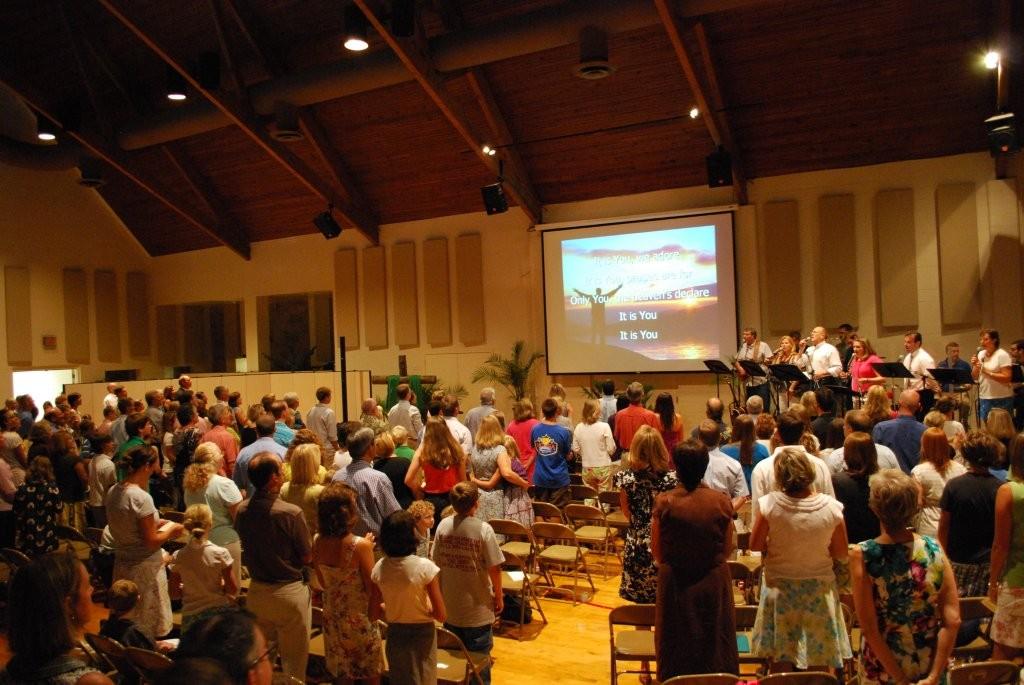
Leading Worship with Limited Resources

September 21st, 2011  |  Published in Spirit

My friend, Alan Knox,  who will not be named in this post, told me about a new seminar being offered by the Baptist State Convention of North Carolina called, Worship Leader Boot Camp: Special Edition (Leading Worship with Limited Resources). Which purportedly “takes the popular Worship Leader Boot Camptraining event, offered throughout North Carolina last year, and changes the direct application of the biblical and leadership principles through practically helping churches with limited resources to engage technology and new ways of thinking to lead worship with only one or two, or perhaps no instrumentalists.” (1) — whatever that means.

By the way, since the seminar is 30$/person plus hotel, “Limited Resources” does not mean limited funds but zero to a few talentless instrumentalists (though one probably begets the other).

I have decided that I am going to be a good Christian and undercut my brothers and sisters in North Carolina. For the low price of 20$/person, I will teach you how you can truly worship with limited resource in just 4 simple verses. But wait! That’s not all, if you read this post now, I’ll throw in an extra Scripture verse that proves my bias! Speaking of scripture, let’s see if we can glean some wisdom in its pages on how to Worship with a few talentless instrumentalists.

  1. Consider killing your son, but don’t (Abraham and Isaac – Genesis 22)
  2. Learn to program a PERL array of hashes (Holy Array – 1 Chronicles 16:29)
  3. Make a footstool (Holy Footstool – Psalm 132:7)
  4. Be IN God’s spirit (True Worshiper – John 4:23)

And finally, the extra Scripture I promised you comes from Song of Solomon 8:8. Commonly referred to as the “proves everything and anything verse”. Since this is only a 20$ seminar, you’ll have to look it up on your own.

I trust you found this exciting course in Leading Worship with Limited Resources helpful. Be sure to check out my next course, How to Kill Your Enemies and Still Love Them.

Tags: , , , ,

Words Not Found in Scripture – Pastor

May 7th, 2010  |  Published in Spirit

I have not done a Words Not Found in Scripture post in a while, so I decided to pull out a quick one for everyone. Today I would like to talk a little bit about the word “pastor”. In the modern Evangelical Christian Church the Pastor is basically the CEO. He runs the show, his vision is cast and the people are expected to follow. We as Christians put a lot of faith in our pastors… which is a little scary, considering the word only occurs in our English translations one time – and probably should not occur at all!

According to Merriam-Webster the word “pastor” is defined as…

A spiritual overseer; especially : a clergyman serving a local church or parish

The English word is dated to around 14th century and is used once in the entire Bible (NASB). The Greek word it is translating is ποιμην (poimen). According to BDAG ποιμην means:

  1. one who herds sheep, shepherd, sheep-herder
  2. one who serves as guardian or leader, shepherd

The Greek word actually occurs 18 times in the New Testament. The majority of those times is in Matthew, Mark, Luke, and John. In these books the word is used to refer to actual shepherds, sometimes the word is used in a parable spoken by Jesus, and sometimes the word is used to refer to Jesus himself (as the shepherd gathering his sheep).

The word occurs three times outside of Matthew, Mark, Luke, and John:

  1. And He gave some as apostles, and some as prophets, and some as evangelists, and some as pastors and teachers… – Ephesians 4:11
  2. Now the God of peace, who brought up from the dead the great Shepherd of the sheep through the blood of the eternal covenant… – Hebrews 13:20
  3. For you were continually straying like sheep, but now you have returned to the Shepherd and Guardian of your souls. – 1 Peter 2:25

As you can see two of the three times are referring to Jesus (once as the “great” Shepherd).

What do we do with Ephesians 4:11?

I think the word in Ephesians 4:11 would be better translated as “shepherds”. Especially since it is translated as “shepherd” every other place in the New Testament. I find it interesting that Paul mentions a few types of people God has put in our lives to help equip us to serve — Apostles, Prophets, Evangelists, Shepherds (Pastors), and Teachers. Ephesians 4:11 is the only time that we see ποιμην being used to describe a type of Christian. Regardless, we seem to ignore several of these types and focus on the one we know (and understand) the least about — Pastors.

If pastors are the shepherds of Jesus’ church, then they should be the ones who reflect Jesus’ shepherding the most. Jesus was a far cry from the CEO’s of today’s churches.

What do you think a Christian shepherd should look like?

Tags: , , ,

Words Not Found in Scripture – Deacon

January 15th, 2010  |  Published in Spirit

A couple weeks ago Arthur Sido posted about Academic Responsibility. His post was about a popular Christian History textbook’s misuse of Scripture regarding the description of a “Deacon”. I spent a few moments gathering some data for a comment on his post and felt like “Deacon” should be my next, “Words Not Found in Scripture.”

Deacon is a really good word for this series because it is more than just a meaningless word. In Christendom we have whole theologies built around the idea of the deacon office. But do we really understand what a deacon is? The word “deacon” occurs five times in the NKJV (Philemon 1:1 & 1 Timothy 3:8,10,12,13). However, the word itself is a transliteration of the Greek word, “διακονος”. διακονος (and it’s verb version διακονεω) occur in the New Testament a total of 66 times. Basically, around 7% of the time, the word is transliterated (or added to the translation)… obfuscating the true definition of the word. According to BDAG the meaning of διακονος is:

1. one who serves as an intermediary in a transaction, agent, intermediary, courier
2. one who gets somethign done, at the behest of a superior, assistant

and the meaning of διακονεω (the verb form) is:

1. to function as an intermediary, act as go-between/agent, be at one’s service
2. to perform obligations,
2a. perform duties, render assistance, serve
2b. wait on someone at table
3. to meet an immediate need, help
4. to carry out official duties, minister
5. care for, take care of

The Facts

  1. διακονος (n.) occurs in the Greek New Testament 29 times
    • Translated “servant” (and it’s derivatives) 18 times – NKJV.
    • Translated “minister” (and it’s derivatives) 8 times – NKJV.
    • Transliterated “deacon” (and it’s derivatives) 3 times – NKJV.
  2. διακονεω (v.) occurs in the Greek New Testament 37 times.
    • Translated “serve” (and it’s derivatives) 20 times – NKJV.
    • Translated “ministered” (and its derivatives) 14 times – NKJV.
    • Translated “administered” twice (2 Corinthians 8:19,20) – NKJV.
    • Translated “provided” once (Luke 8:3) – NKJV.
  3. 1 Timothy 3 has the word διακονος twice, in 3:8 and 3:12.
    • Both times it is transliterated as “deacon”, but in 4:6, it is translated as “servant” or “minister”.
  4. 1 Timothy 3 has the word διακονεω twice, in 3:10, 3:13.
    • In 3:10, the word διακονος is not in the Greek at all, yet the translators felt it was necessary to add “as deacons” after “let them serve”. Where “serve” is the actual translation of the word διακονεω.
    • Similarly with 3:13, the word διακονος is not in the Greek at all. The translators add “as deacons” after the “for those who served.”
  5. Jesus was called a διακονος (Romans 15:8).
  6. Paul was called a διακονος (1 Corinthians 3:5, 6; Ephesians 3:7; Philippians 1:1; Colossians 1:23,25).
  7. Jesus came to διακονεω (Matthew 20:28; Mark 10:45; Luke 22:27).

Conclusion

Based on my research and studies, I have come to the conclusion that there is no such thing as a “deacon” in the traditional sense of the word. A “deacon” is merely a servant, not an office to hold. The noun and verb in the Greek is translated “serve” 38 times, “minister” at least 22 times (25 if you count “administered” and “provided”). Only 3 times is it transliterated as “deacon” and twice it is added to the English text. So why did the translators believe that they should not translate the word in those places? Frankly, I find this very disturbing.

So, for all of you churchers who argue about deacons during business meetings. I’m sorry to tell you, you’ve wasted a lot of time. A “deacon” is not an office, it’s not someone who is voted on, a deacon is the person next to you who has been serving you and ministering to your needs. A deacon is the person who does not care about the title “deacon” as much as they care about the needs of those around them.

Tags: , , , ,